
Celebrating National Nonprofit Day: A Look into SAFE’s Ecosystem and Collaboration with Austin’s Network of Support
Written by Valeria Perez
By the time someone reaches SAFE, they may have already talked to a teacher, a doctor, a police officer, a friend, or a judge. Every one of those offices has its own intake, its own forms, or its own stranger to convince. No agency knows what the last one has already asked. So, the story gets told again, and again, while the survivor is still working, still parenting, and is often, still in danger.
Survivors of domestic violence, sexual assault, and trafficking shouldn’t have to relive what happened to them across separate offices or systems that don’t talk to each other. A survivor’s needs don’t arrive one at a time, so we didn’t build our services that way— and neither did the community around us.
SAFE’s Ecosystem of Care
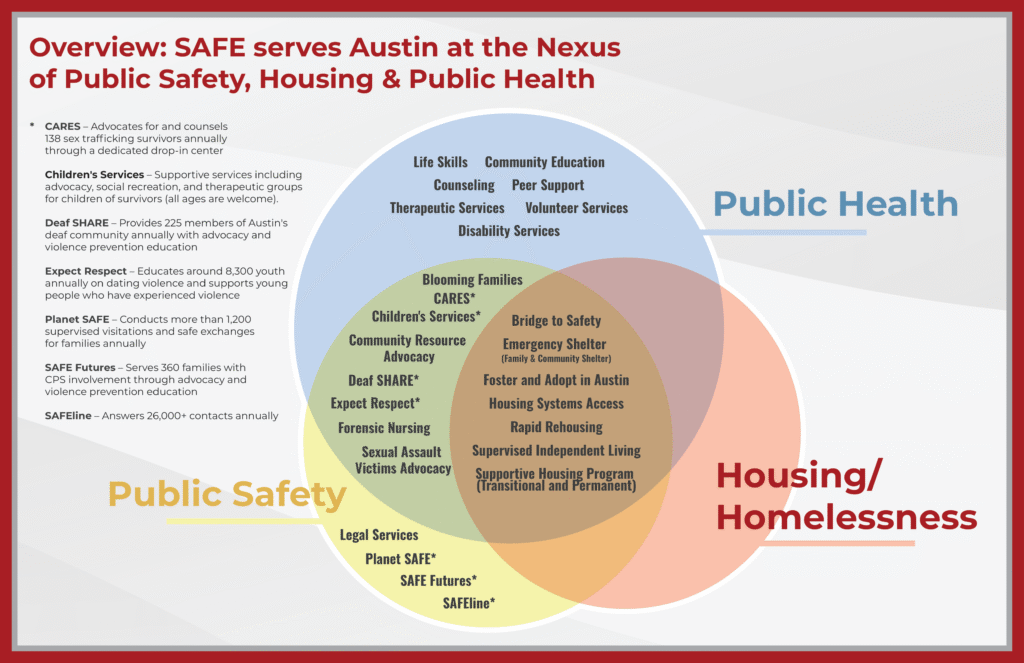
We call this an ecosystem of care because violence, housing, and health are almost never separate problems and rarely do they require the same solutions. Someone fleeing danger may need counseling to process trauma, legal advocacy to navigate the courts, and housing support to rebuild stability — often all at once, and often on the same week’s calendar.
So, our services are built to meet the range of what a survivor needs, and to travel with them when the next step lies outside our walls.
Having our programs under the same roof looks like:
- The same advocate who sat with someone at the hospital is the one who calls to check in a month later, when the adrenaline has worn off and readiness to engage in therapeutic support may look different.
- A parent in shelter doesn’t have to find childcare to attend a job interview, because children’s services are down the hall.
- When a CPS case opens, we already know the family. They don’t have to explain their history from scratch to one more agency.
Consider a mother who was told by CPS that unless her children had beds, they would be removed from her care. She had no money for mattresses and no way to move them if she’d found them. On its own, that requirement is nearly impossible to meet in the time given — and the consequence of failing it is losing your children.
Because her advocate could reach across our own programs, the beds came from SAFE’s Warehouse and were coordinated and delivered on her behalf. She didn’t have to source them, finance them, or transport them. Her family stayed together.
That is one item, on one day, in one case. But it is the difference between a family intact and a family separated — and it happened because the person helping her didn’t have to send her somewhere else to ask.
When survivors are no longer required to start over at every door, it means they don’t fall through the space between programs, and they no longer become their own case manager while in crisis.
We are a large organization with a wide range of services, and we still aren’t the whole answer.
We aren’t licensed for long-term behavioral health care. We don’t offer in-house treatment programs for substance use recovery. We don’t have an employment preparation program. Some things, other organizations simply do better — and we’d rather connect survivors to the people who specialize in the care they need.
And that goes both ways – our community partners rely on SAFE to provide services we’re specialized in that they don’t provide in-house.
How We Continue our Support Outside of SAFE
When someone needs support SAFE is unable to provide, we don’t just give them a number for another agency and end our service with them.
SAFE will still provide support to connect survivors to their next needs. For example, an advocate may be the one driving them to the partner organization, managing the appointment, walking in with them, and introducing them by name to the person who will help them next. The same is true at the courthouse, and the same is true with law enforcement— our advocates go with survivors into those systems instead of pointing toward the door and stepping back.
That’s the difference between an institutional handoff and a trusted advocate introducing you to someone they trust. It’s how SAFE’s ecosystem of care connects to Austin’s larger network of support.
Austin’s Network of Support
SAFE is proud to be one part of Austin’s broader network of support— its homelessness response system, its public safety system, its public health system. Our community network of providers work symbiotically to address these issues: partners send survivors to us for the specialized care we provide, just as we send people to them.
- LifeWorks provides housing and stability for youth and young adults working to build independence.
- Caritas of Austin meets basic needs and helps families stabilize when one crisis threatens to become several.
- Asian Family Support Services of Austin serves Asian and immigrant survivors of domestic violence, sexual assault, and trafficking with the culturally and linguistically specific care their community needs.
- Local food banks make sure no family is forced to choose between safety and their next meal.
SAFE’s job isn’t to be the only place a survivor ever needs. It’s to do our part well, and to trust the rest of this community to do theirs. That’s what safety looks like when it’s built as infrastructure instead of a single program. It’s a community of interconnected care, where we collaborate to meet the needs of those who turn to us for support. We’re proud to be part of Austin’s network of services Austin that keep our city safe.

