
How to Support a Teen Who Discloses Relationship Violence: A Guide for Parents, Educators, and Trusted Adults
Written by Valeria Perez
One in three teens will experience some form of violence in their relationships.
We not only have a responsibility to keep our teens safe—we have an opportunity to end this cycle of relationship violence once and for all.
When a teen trusts you enough to disclose that they’re experiencing violence, how you respond can make all the difference. Your reaction can either open the door to healing or shut it down completely.
This guide will help you respond with care, compassion, and competence.
What Teen Dating Violence Really Looks Like
Before we talk about how to respond, let’s be clear about what we’re responding to.
Teen dating violence isn’t just physical abuse. It includes:
- Emotional abuse: Name-calling, put-downs, constant criticism, humiliation
- Digital abuse: Monitoring texts and social media, demanding passwords, sharing intimate images without consent, using technology to track or control
- Sexual abuse: Pressuring or forcing sexual activity, refusing to use protection, distributing intimate images
- Physical abuse: Hitting, pushing, choking, restraining
- Economic abuse: Controlling money, preventing someone from working, creating financial dependence
- Manipulation and gaslighting: Making someone question their reality, denying abusive behavior, blaming the victim
Teens are already thinking and talking about relationships. They turn to one another for advice and guidance. But when that advice comes from peers who don’t have the full picture—or worse, from toxic online sources—it can reinforce harmful patterns.
This is why skilled adult support matters. This is why how you respond matters.
How to Respond: The DO’s
✓ Believe. Listen. Support.
The most important thing you can do is believe them. Don’t question whether it “really” happened or minimize their experience. Trust is fragile, and if a teen senses doubt, they may never open up again.
✓ Create safety to discuss emotions and feelings
Normalize their feelings—whatever they are. Survivors often feel confused, scared, angry, or even love for the person harming them. All of these feelings are valid and normal responses to trauma.
✓ Allow them to regain control by making choices
Abuse is about control. Healing is about reclaiming it. Let them make decisions—even small ones like what to eat for dinner or what movie to watch. This rebuilds their sense of agency.
✓ Allow them to recover and heal at their own pace
There’s no timeline for healing. Don’t impose expectations about how long recovery “should” take or what it “should” look like.
✓ Provide information about the healing process
Help them understand that healing isn’t linear, that feelings may come in waves, and that what they’re experiencing is normal. Knowledge reduces fear.
✓ Understand their legal rights
Familiarize yourself with reporting requirements in your state, protective order processes, and their rights as a minor. Be prepared to provide accurate information or connect them to someone who can.
✓ Encourage communication by modeling openness
Don’t avoid the subject. Remove the stigma of talking about relationship violence by being willing to have honest, open conversations.
✓ Educate yourself about rape myths and your own biases
We all absorb harmful cultural messages about violence. Examine your own assumptions: Do you unconsciously blame victims? Do you minimize certain types of abuse? Awareness is the first step to unlearning.
✓ Remind them that violence was not their fault
Say this explicitly and often: “What happened to you is not your fault. You did nothing wrong. The blame belongs entirely to the person who hurt you.”
✓ Continue to live and talk the way you always have
Don’t treat them like they’re broken or fragile. Consistency and normalcy are healing.
✓ Show affection—but respect boundaries
They may pull back from physical contact. Wait until they bring up the subject of intimacy or affection. Let them lead.
✓ Ask what concerns them most and listen seriously
Their biggest fear might surprise you. Maybe it’s not about the violence itself but about being believed, being judged, or losing control over their story. Listen to what they need.
✓ Provide information about support services
Connect them to resources like Expect Respect support groups, SAFEline (512-267-SAFE), counseling, or legal advocacy. But don’t force it—offer information and let them decide.
✓ Take care of yourself
Supporting a survivor is emotionally demanding. Seek support for yourself from someone other than the teen. You can’t pour from an empty cup.
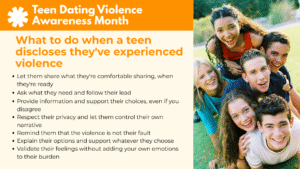
How to Respond: The DON’Ts
✗ Don’t blame the survivor
Never ask questions like “Why didn’t you leave?” or “What were you wearing?” These questions place responsibility on the victim, not the perpetrator.
✗ Don’t pressure them for details
Don’t ask probing questions or focus on the sexual or violent aspects of what happened. It’s their recovery, and they need control over when and how they share their story.
✗ Don’t tell their story without permission
Respect their privacy. Don’t share what they’ve told you with others—including other family members—without explicit consent.
✗ Don’t make decisions for them or be overprotective
This can recreate the dynamics of the abusive relationship. Empower them to make their own choices.
✗ Don’t try to distract them or avoid the subject
Healing requires processing, not avoiding. Don’t shut down conversations about what happened.
✗ Don’t impose timelines on their recovery
Recovery doesn’t happen on a schedule. Trust their process.
✗ Don’t communicate themes of revenge
While your anger at the perpetrator is understandable, talking about revenge may heighten the survivor’s worry about safety or retaliation.
✗ Don’t question their decision-making during the incident
“Why didn’t you scream?” “Why didn’t you fight back?” If they survived, they made the right choice. Full stop.
✗ Don’t forget your own limits
It’s okay to express your boundaries to the survivor. You can be supportive and have limits at the same time.
Resources
- If you or someone you know needs help: SAFEline 24/7 at 512-267-SAFE (7233)
- To bring Expect Respect to your school or community contact Shannon Sandrea at ssandrea@safeaustin.org or expectrespect@safeaustin.org
About The SAFE Alliance
The SAFE Alliance is the largest anti-violence organization in the South and the 3rd largest in the nation, providing comprehensive services to survivors of child abuse, sexual assault, domestic violence, and sex trafficking. Our Expect Respect program serves thousands of teens, families, and educators each year with prevention education, support groups, youth leadership development, and systems-level change in schools across Central Texas.

